Monday, March 5, 2012

Tips for a low water use garden in the California high desert

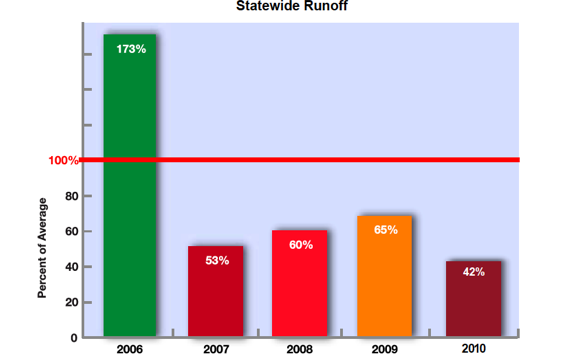
The total statewide October through December precipitation was 78 percent of average, further adding to our accumulated water supply deficit.  The 2009 Water Year (October 1, 2008 through September 30, 2009) was the third consecutive year of below average precipitation for the state. Annual statewide precipitation totaled 76 percent, 72 percent, and 63 percent of average for Water Years 2009, 2008, and 2007, respectively.
On the bright side, January precipitation through the 28th is above average January rainfall.

So what do you do in this situation? Give up gardening all together? Mainstream agriculture uses about twice as much water (and maybe much more!) to irrigate as a small scale, organic and well planned home garden. It almost seems to be a better thing to grow your own vegetables in a drought. But to do it thoughtfully. 
  1. Grow Your Crops Before the Summer Heat Starts – Instead of doing a heavy summer planting, do the majority of your planting in spring with short season vegetables. Plant lettuce, peas, radishes, spinach, beets, onions, garlic and broccoli all which thrive in the cooler spring weather. Keep your summer plantings spare and then when fall arrives you can replant the same things you did in spring.
  2. Plant Drought Tolerant Vegetables – Some vegetables don’t need as much water as others. Amaranth, cow beans, corn, mustard greens, purlane, spinach, tomatoes, chard and a few others don’t need as much water. You buy a Drought Tolerant Seed Mix. The Veggie Patch Reimagined has a great list of drought tolerant plants. And you can read more about  drought tolerant vegetables here too.
  3. Herbs-Herbs are the perfect plants to start with when planning on incorporating xeriscaping into the home garden.Herbs are naturally hardy and many are drought resistant due to being native to the hot dry Mediterranean region of the world. Herbs like cilantro, rosemary, marjoram, thyme, bee balm, oregano and sage are perfect for using in a low water usage garden. Herbs are highly adaptable and easy to grow. They don't need much maintenance either other than keeping them from spreading all over the yard.
  4. Double or Triple Dig Your Beds – While double digging is a common idea in America with organic gardening, in parts of Africa they triple dig their beds. Their crops are much more successful than their non-digging neighbors gardens. If you aren’t familiar with double or triple digging, basically you dig out the first layer of soil about one shovel deep. Then you dig out a second layer and if you are really ambitious then you can dig out a third layer. Doing this aerates your soil making it easier for the roots of your plants to grow down, thus making it easier for the roots to pick up the water that is already deep in the soil.
  5. Add Compost to Your Soil – Having your garden beds be composed of at least 2% of compost will help your soil retain a great deal more water.
  6. Mulch – Adding a 3-4 inch layer of mulch to your garden beds will do wonders. I found it amazing what a difference this made to my flower beds years ago. A night and day difference in the health of the plants once dry old August came around. You can use either compost, grass clippings or straw as mulch (there are many more mulch options too).
  7. Water at Night – In thinking of using your water to it’s best advantage, water in the evening. Most vegetables do most of their growing at night and that is when they’ll need the most water. If you water in the morning or mid-day, most of it will evaporate and not benefit the plant at all.
  8. Water the Right Amount - If you are watering from a hose, you should water just long enough for the top layer of soil to look shiny. Once it looks shiny, turn off the hose. It should remain shiny for 3-5 seconds after you turn the water off. If the ’shine’ wears off faster, water a bit more, if it takes longer to soak in, water less.                       
    Critical watering periods for vegetables. You can target the timing and amount of water to add. As a rule of thumb, water is most critical during the first few weeks of development, immediately after transplanting, and during flowering and fruit production. The critical watering periods for selected vegetables follow:

  9. Asparagus needs water most during spear production and fern development.


  10. Broccoli, cabbage, Brussels sprouts, kohlrabi and cauliflower need consistent moisture during their entire life span, especially during head or root development. Water use is highest and most critical during head development.

  11.        
           

  12.        
           

  13. Beans have the highest water use of any common garden vegetable, using 0.25 to over 0.50 inches of water per day. Beans need water most when they are blooming and setting fruit. When moisture levels are adequate the bean plant is a bright, dark grass green. As plants experience water stress, leaves take on a slight grayish cast.


  14. Carrot and other root crops require consistent moisture. Cracking, knobby and hot flavor root crops are symptoms of water stress.


  15. Corn needs water most during tasseling, silking, and ear development. Yield is directly related to quantities of water, nitrogen and spacing.


  16. Lettuce and other leaf vegetables need water most during head development. For quality produce these crops require a consistent supply of moisture.


  17. Onion family crops require consistent moisture and frequent irrigation due to their small, inefficient root system.


  18. Peas need water most during pod filling.


  19. Potato tubers will be knobby if they become overly dry during tuber development.


  20. Tomatoes, peppers and eggplant need water most during flowering and fruiting. Blossom-end-rot (a black sunken area on the bottom of the fruit) is often a symptom of too much or too little water. Watch for overwatering.


  21. Cucumbers, summer and winter squash, and other vine crops need water most during flowering and fruiting. Watch for overwatering

  22. Install Irrigation on a Timer – The best way to water plants properly and save the most amount of water is to install some sort of irrigation that is regulated by a timer.
  23. Plant Vegetables Close Together – There are many advantages for planting your veggies close together. But in thinking of water preservation, planting things close together creates a canopy layer over the soil, which shades it and prevents evaporation.
  24. Choose Plants that Produce in Abundance – When water becomes a precious commodity, when it comes to gardening, you want the most bang for your buck. Plant vegetables that produce a copious amount of edibles. Tomatoes, squash, peppers, eggplant among many others produce many meals worth of produce. Broccoli and cauliflower both take up a large amount of space and water and only really produce enough for one dinner, maybe two.
  25. Try Dry Farming Your Tomatoes – Some people swear that by dry farming their tomatoes they acheive the best flavor possible. To do this you have to really build up your soil with organic matter by way of adding compost and growing cover crops. Then basically you plant your tomatoes and let them grow without watering. You only water when their leaves start to turn yellow and then you do so rarely and deeply. Once the tomato plant develops fruit you stop watering all together. This allows the plant to focus not on new growth, but developing the fruit. You tomato plants will be ugly and straggly by doing this and your yield will be small, but you’ll have great tasting tomatoes.
  26. Place Drainage Pipes Between Crops – By using the technique that we’ve learned over the years of placing drainage pipes between tomatoes, we’ve been able to cut down to watering our tomatoes only once a week, if that.
  27. Use Grey Water from the House – We’ll be buying some large buckets with sturdy handles and maybe a rain barrel for outside to fill with our indoor grey water. Any water remains from washing things out in the salad spinner, cold water before a hot shower, etc will be put in these buckets for watering the garden.
  28. Don’t use Roof Water – From the reading I’ve done, it is not safe to use roof water collections to water edibles. The water picks up whatever chemicals are in your roofing and make it not such a healthy thing to water your veggies with. Leave that for the ornamentals only. And it isn’t like we are getting much rain to catch this way anyway. We’ll be skipping this step.
  29. Olla gardening - Another alternative to this problem might be "olla" (prounounced oh-yah) gardening. This method was brought to the new world by the Spanish, but is thought to have developed in the deserts and arid regions of northern Africa and brought to Spain by the Moors.
    Unglazed terra cotta pots are porous. Water seeps slowly from them through the tiny pores. In New Mexico and elsewhere, these terra cotta pots are buried, with the top at or just below ground level (this keeps hot sun and wind from wicking the water from around the rim of the pot). If there is a hole in the bottom, it is plugged (marine caulking works well). Edible plants (and ornamentals) are planted in circles around the pots. The pots are then filled with water and covered (old plates, slate, a flat rock, a piece of wood...anything to keep the water from evaporating.)
    The water slowly seeps through the terra cotta into the soil (and the plant roots next to the pots). Very little water is wasted through evaporation. Check the pots every day to check water levels. When a pot gets half-empty, refill it.
    Ollas can be small (eight to 10 inch pots) or very large (a foot or two across). Plant roots benefit from this because all the water is going right where it's needed, and there is little or no evaporation. Also, with the pots, it is easy to maneuver around the garden. You can experiment with several designs.
    The Santa Fe, New Mexico Master Gardeners Association has an Olla Experimental Garden. Here's their website address: http://sfmga.org. When you get to their homepage, click on "Projects", then scroll down to the bottom of the projects. The Olla Garden page link is the last one.
  30. Windbreak - Erect a temporary windbreak next to your garden to protect it from drying winds during extended periods of drought.  I'm also thinking of putting grape trellises overtop the garden to prevent so much sun from hitting it.
  31. Sunken Beds - You can read my article on sunken beds for more info, but basically raised beds serve to dry out plants which is just what you don't want in the desert.  Sunken beds keep them wet longer and conserve the water.
Do you have any water saving tips that we can add to our list? I’d love to hear them…we need all the water tips we can get.

Much of this post is from asonomagarden.wordpress.com

Sunken garden beds

I decided to try something different this year with my garden.  Last year I had raised beds.  It worked great for having soft soil and it wasn't too much work because I just dug out the paths and piled it onto the beds so I didn't have to bring in soil from somewhere else.  However, the point of having raised beds is also to keep the plants roots from drowning in excess water.
As you can see, the plants roots are safely away from the water with the freedom to grow down to the water as needed without the roots rotting.
However, I live in the desert where we get an average of 3 inches of rain a year.  Yes, that's right, 3 whole inches.  Occasionally, like this year, we're getting a lot more...like 6 maybe.
So instead of moving the plants away from water that's too close to the surface (because there's so much water in the soil), I'm digging the beds deeper so that the plant is closer to the scarce water, which is further down in the ground.  
Great idea right?  Well, yea it is.  It means we won't have to water as much or as often and it means that the plant gets shaded somewhat from the scorching desert sun...of course, it's also been one heck of a workout digging 2 feet down into the soil.  
It shouldn't be so hard, but I decided to convert a part of the horse area into the garden.  The horses always congregate in this area so it had probably a foot of manure in it.  That's getting way too unhealthy for the horses and the environment, so the best thing to do is turn it into a garden so all that fertilization can turn into nice healthy plants.  The bad thing is that the horses have been standing in that area and compacting it for the past five years.  There were layers of hay and manure, hay and manure until there was about 6 inches of hard as a rock compost.  It's taken me days to break through it in even a few beds.  It'll probably take me a month to break through the first 6 inches in every bed (probably about 20 beds in all).

I've finally broken through to the easy soil on the first bed to the left.  The other beds are in varying levels of progress.  I'm soaking them with water to make it easier.  You can see how well they hold water.  When it rains...if it rains...the water will naturally collect in these areas instead of in the paths as would happen in a raised garden.
Now there have been suggestions to get someone out with a bobcat or a bulldozer.  That would have made this sooooo much easier.  However, bulldozers use gas, which is a precious nonrenewable resources.  Plus, having just gotten over a severe potassium deficiency in which I lost 40 pounds of muscle-I want to do this myself (well, with some help from family and friends).  I'm hoping it'll build back all the muscle I lost...and of course that I'll lose all the fat I gained lol!  There's nothing like gaining 70 lbs in 6 months because an idiot doctor prescribed medicine without having any idea how it worked. Ouch!
So the next step is to finish digging them out, then put all the manure back in that I dug out so that the bed is nice and fertilized.  The beds will be filled up a foot or maybe a foot and a half so that they're 6 inches to a foot below ground level.  Then just let them sit and compost until March or so when the risk of frost has passed.
For now though, I'm going to go take some Advil for my aching muscles...

Check out Growing Radishes in the Desert for more info about sunken beds


Cooking tips for eggs

Just so that everyone knows, whenever you cook eggs make sure that you don't leave them boiling for so long that all the water boils out.  Here's why:


and

Luckily, I'd NEVER do anything like this.  Some of you might say, but Serina, I've been over to your house and those pictures look JUST like your kitchen.  Weird coincidence, huh?  It looks just like my kitchen and my pots and tea pot, but it isn't because I would never be so silly as to leave a small pot of water with eggs in it boiling while I went out to feed the horses, fence fixes and train one of my horses for over an hour.  Nope, I'd never do that.  So it's just a strange coincidence that the pics look just like my house.

Note:  Also check the ceiling for egg

Farm Therapy decreases stress, anxiety and mental illness

OSLO (Reuters) - Spending time on a farm looking after cows, horses, or other animals can help people with mental illness better manage their anxieties and increase their confidence, according to a study published on Friday.
The findings by Norwegian scientists could further widen use of "Green care", which enlists nature to ease patients' suffering.
"Looking after and having contact with farm animals has some positive effects on psychiatric patients with a diversity of serious illnesses," said lead author Bente Berget of the Norwegian University of Life Sciences in Aas, west Norway.
She told Reuters that looking after pets such as cats and dogs has long been known to help some psychiatric patients but Friday's study was the first scientific assessment of benefits of working on farms.
About 60 patients who visited farms in Norway showed significant improvements in coping with anxiety and in their confidence in managing new situations, compared to a group of 30 other patients who did not look after animals.
The patients -- suffering from schizophrenia, anxiety, personality or emotional disorders -- visited a farm for three hours twice a week for 12 weeks and worked mainly with dairy cows, cattle raised for meat and horses.
The farms also had other animals around such as rabbits, chickens, cats or dogs.
The improvements were shown by patients' answers to questionnaires before and six months after the farm visits, according to the study in the journal Clinical Practice and Epidemiology in Mental Health (www.cpementalhealth.com).
"The use of farms in promoting human mental and physical health in cooperation with health authorities is increasing in Europe and the United States, particularly under the Green care banner," a statement about the study said.
"Historically, the approach was associated with hospitals, psychiatric departments and other health institutions but today, most Green care projects involve community gardens, city farms, allotment gardens and farms," it said.
Berget said more study was needed but that looking after farm animals could suit some patients -- unlike pets, farm animals like pigs or sheep do not require a 24-hour commitment.
The study tried to ensure that the patients' positive responses were not caused by the kindness of a farmer or some other factor unrelated to the animals. During farm visits the patients were not, for instance, given coffee breaks.
(Editing by Mary Gabriel)

There goes the fence

Well, I spent yesterday dragging wooden pallets and setting up a fence only to have the wind blow it down today.  You can see how windy it was by looking at Wookie.  That's an actual picture of my poor dog and that's in the barn, not even where it was the windiest.  
The hay pallet fence was a great idea.  The pallets were free and just laying around providing a home for lizards.  
I wired them together and drove wood stakes into the ground for support.  I guess it wasn't enough though.  I'm going to try driving in more stakes before I give up.

Working on the orchard

Here's a pic of the orchard.  We've really been trying to get the trees pruned in time for spring, but spring is beating us.  There's a lot of work to do.  The trees haven't been pruned in years and are twisted and dying and really bad.  Some have a good foundation and others are simply hopeless.  Do you see the blue barrels in the background underneath the rainbow?  Those are to provide water for the coyotes that come and chew up our drip irrigation system.  We finally figured out how to stop them so we don’t have to fix the lines daily.

A rainbow...there really is gold in those hills...


Thursday, December 9, 2010

Sa day for food freedom


By Dr. Meg Howe

http://prepare4change.blogspot.com/2010/12/sad-day-for-food-freedom.html


Formerly called Food Safety Bill S510, this Bill is NOT About Food Safety. It is a draconian piece of legislation that literally places food under the control of the Department of Homeland Security, the organization created supposedly for foreign terrorists. Now, the DHS has the legal power to seize food production, force recalls, and shut down any farms it deems unsafe. This includes your backyard garden - should you want to sell anything you produce on your land, or even give away to a neighbor.

So it is now a revolutionary act to grow your own food, and we hope you all do!

Wherever you are located we urge families to develop their own square foot gardens and become as independent as possible from the attempt to control our food to restrict our freedoms. For help on how to grow your own healthy food see the Natural Solutions Foundation’s Food Freedom Journal at http://www.healthfreedomusa.org/?p=2788.

Better buy yourself some heirloom seeds while you still have the chance.

In this video made prior to the passing of the bill, Glenn Beck explains the implications and urges people to express their opposition to it:


Here, Dr. Rima E. Laibow MD, Medical Director of Natural Solutions Foundation, urges First Lady Michelle Obama to intervene on behalf of the people: